Saturday, April 23, 2011

Proto-semantics: Where cognition meets language

A recent Nature paper entitled Evolved structure of language shows lineage-specific trends in word-order universals has made quite a splash in the media and has some important implications for the study of linguistics and application of linguistic principles. The splashy aspect of the paper is that it allows the media to declare the discovery of purported fundamental flaws in the theory of Universal Grammar.

The more subtle implications of the research are highlighted in an Wired Science article entitled Evolution of Language Takes Unexpected Turn. This article quotes Michael Dunn, author of the Nature paper, as stating, “What languages have in common is to be found at a much deeper level. They must emerge from more-general cognitive capacities.”

This finding suggests that if we indeed are interested in understanding our human language capacity, it is time to return to again give serious consideration to proto-semantics, the pre-lexical dimensions of meaning arising from the interaction of our human perception and the real world in which we live. The commonality underlying the way we speak arises from the similarity of our cognitive processes, which in turn can be traced to the structure and function of our brains. The way in which proto-semantics is encoded into the wide range of human languages and the variety of the evidence that we can observe of its existence are re-emerging as the more critical research questions. Whether we need a universally applicable syntactic mechanism to explain language may at this point be less relevant.

As a scientist, I personally renegotiated my relationship with Universal Grammar 15 years ago while doing the field work in theoretical linguistics on Baule in Cote d'Ivoire. No amount of pushing and shoving would fit the verb series constructions that I was studying into a framework determined exclusively by settings of universal language parameters previously identified in other languages. It appeared to be a classic case of West Africa Wins Again. My laptop held up wonderfully under humidity, sand and travel in the Cote d'Ivoire -- but my fine theory failed miserably.

One aspect of Baule that I looked at in detail is the conditions under which it is possible to omit a pronoun object in a sentence. In answer to the question "Did you beat the drum?" one replies "Yes, I beat", which must be translated into English as "Yes, I beat it". You leave out the pronoun because (simplifying somewhat) the drum is an object whose purpose is to be beaten (in the sense of played). The functional relationship in the real world as perceived by humans makes the verb and its object inextricable with respect to their meaning. The pronoun is considered redundant and can (in fact, must be since the effect is encoded into the grammar of the language) left out.

Contrast that with "Did you see the drum?" and the answer "Yes, I saw it". Here, the acting of seeing and the drum itself do not have a tight connection in the cognitive conceptualization of the world. The drum is seen because it has a physical existence, but it is not explicitly designed to be seen nor can it be considered an object typical of the sorts of objects that are seen by humans. In the answer "Yes, I saw it." it is not possible to omit the pronoun.

The syntax of Baule failed to fit into my neat universal framework, but I learned an extraordinary amount about the range of phenomena that "register on the radar" of human cognition and naturally also find their way into language. Other languages express these phenomena in other ways, or chose not to express them at all. However, that proto-semantic generalizations can be found to exist at all and which generalizations exist is both interesting and useful.

What does this have to do with search (the topic of this blog)? If proto-semantics is a reflex of human perception of the real world, we should expect that its influence impacts not only relatively low level syntactic processes, but also the more complex ways in which humans communicate and exchange information: information creation, curation and retrieval. If we can push forward this line of inquiry, a full answer to this question will surely be important enough to make its own splash.

Sunday, April 17, 2011

From the Rialto: On the Relevance of Geotags

This weekend I am in Venice in between an Networked Media and Search Systems Concertation meeting and ICMR 2011. I am in the processing of preparing the slides for a talk [1] that I will give on Tuesday morning on tagging and geotagging. Once again, I find myself busy with the question of what does it mean for a geotag to be relevant to a photo.

At first blush, the answer to this question is obvious: A geotag is relevant to a photo if it gives the exact longitude and latitude of the position of the camera when the photo was taken. I have this information for the photo above, which was taken earlier today -- but it reflects so little of the larger story. On the one hand our cameras (in this case we're using a new Android phone) pin us down and on the other they tell not much at all.

I originally asked this question about the relevance of geotags after the talk of Pavel Serdyukov at SIGIR 2009, "Placing flickr photos on a map." I garbled the formulation, Pavel didn't understand it, and I have since come to understand the large number of dimensions involved in the answer. "Where does a photo truly belong on a map?" isn't an obvious question and doesn't have an obvious answer, either.

It's generally accepted that knowing the position of the photographer underspecifies the location of the photo since it is not known in which direction the camera was pointing or on what it was focused. It could possibly be the case that the subject of the picture is quite far away from the photographer, making the geo-coordinates of the photographer not the most relevant position to the photo in terms of the depicted content.

The photo from today is a good example. It was taken in Venice, but it is also relevant to Trento, since I am here in Italy on a trip to Trento and only happened to come to Venice for the weekend. I will remember the trip as a "Trento" trip. But the Trento association goes beyond my own personal sense of the proper place of the photo -- anyone who was on a business trip to Trento might find Venice related since they are possibly flying into a Venice airport or like myself also planning a touristic stay in Venice.

The sign in the background says "Per Rialto" and is pointing the way towards the Rialto bridge. We're on our way to the bridge and have taken the photo along the way -- it is relevant to the geocoordinates of the Rialto bridge in the sense that this was the final destination of the walk.

The photo was taken for my family back home. My great uncle is sick and in the hospital at this moment. He is a central node in my extended family and ties us together across space and also across time -- and for years has passed along to us the lore of the generations that preceded us -- a mixture of stories, poetry and family values -- a nourishing flow that sustains us and binds us together. One of the things that he does is write email newsletters to the family members and this newsletter has a section that is called "From the Rialto", which describes the current activities of various family members. Here I am sending my own thoughts out from the Rialto to my family back home and my great uncle in the hospital. The picture has more to do with them and where they are than here.

Further, I don't really remember why the section of the newsletter is called "From the Rialto". It might not be the Rialto in Venice (which is actually an entire district and not just a bridge). It might be an entirely different Rialto. My picture is actually related to the original Rialto used by my uncle, except that I don't know where that is. I will admit that there are probable not a lot of photos out there that enjoy this sort of relationship to place -- but the main point is the existence of possibly relevant places that the person who takes the photo is not necessarily aware.

Actually, I just wanted a picture with a Rialto sign in the background. These signs are numerous in Venice...in fact they sell T-shirts on which they are depicted. In a certain way, the photo is a "Woman in from of Rialto sign" picture and is also relevant to anywhere else a Rialto sign is located. In a way, I am standing at place that has many different geo-coordinates.

The renown of the Rialto bridge is attested by the numerous replicas that exist, for example, in Las Vegas. The original and its imitators are related -- photos of one are of interest to people visiting the location of the other. It would be useful for a picture of the Las Vegas Rialto bridge to bear a tag that relates it to the one here in Venice.

I briefly entertained the idea that it is generally accepted that the relevant geocoordinates for a photo are the ones at which the photographer is standing, since those geocoordinates would be considered relevant to the widest range of people, i.e., be the most objective. Indeed, this is the relevance criteria for geotags that we apply within the MediaEval Placing Task. My association of the photo with the folks back home is relevant to a handful of souls, whereas anyone could recognize the connection with this corner of Venice. However, replicas are part of a common shared culture across the world and the connection between an image of a replica and the geo-coordinates of the original could be considered of possible interest to anyone and not just a personal circle.

Finally, there is the question of the relevant geographical resolution. For me, this is a "Venice" picture. I don't need to know the exact corner again -- nor will I try to find it. We overheard a group of Americans talking about their vacation -- and noticed that they referred to themselves not as being in Venice or in Italy, but in Europe. Europeans hardly ever reflect upon the fact that they are in Europe...they take it for granted.

Wandering through Venice its tempting to just fall into people watching -- making up small stories about couples out enjoying the good weather and the beautiful city: how they met, how they fell in love and what the future has in store for their mutual happiness. The relevance of the geo-coordinates of the photographer is obvious for those who want to take people watching to the next level -- if the couple standing next to us a bridge near San Marco uploads their pictures to Flickr, we will know even then more about them...we could check if their trip to Venice provided the solid basis for a stable relationship, or whether they ended up parting ways. Taking the people watching to the extreme: It would finally be possible to check whether kissing under the Bridge of Sighs does its work in guaranteeing everlasting bliss.

[1] Larson, M., Soleymani, M., Serdyukov, P., Rudinac, S., Wartena, C., Murdock, V., Friedland, G., Ordelman, R. and Jones, G.J.F. Automatic Tagging and Geotagging in Video Collections and Communities. ACM International Conference on Multimedia Retrieval 2011.

Sunday, March 27, 2011

Your mistrokes are costing me keystrokes

My mother insisted that I learn how to touch-type in high school and so I spent a summer after ninth grade or so pecking out the obligatory practice sequences.

At times I've caught myself being vain about my ability to take notes in lecture on my laptop and still make eye contact with the speaker. That's balanced by the many meetings in which I've taken minutes because it was uncomfortable to watch my colleagues engaged in seek and hit missions to input even simple sentences. And also by colleagues who are utterly unfazed by my scripting proficiency, but who light up when I am able to turn to smile as they walk in without breaking my stride in the e-mail I'm writing, "Hey, you can look at me and still type!"

Well, Google has found a way to keep me humble and to break down any remaining feelings of typing elitism. I type in a perfectly formed query, work meaning wired and Google finds it necessary to give me results for word meaning weird (check out the screen shot). My query is meant to find me the Wired article that I read in the UK edition on Thursday about a study that had been done at Duke about the meaning of work. I want to have another look at it so see if I can relate it to issues of worker engagement in crowdsourcing -- work that I currently collaborating with my colleagues on.

Evidently is what is happening is that the words "work" and "wired" are mistyped so frequently by searchers, especially in the context of the word "meaning", that the probably of me actually having meant to type work meaning wired is vanishingly small, or at least has fallen off the bottom of the Google charts.

I permit myself a half formulated cuss, well under my breath, and then I type in "work" meaning "wired".

OK. Well, my complaint about the wasted keystrokes may not be my only complaint: the extra apostrophes don't get me the article I want either.

But I do serendipitously stumble across a blog post urging scientist to move beyond papers and discuss the importance of their findings in blogposts: http://www.wired.com/wiredscience/2010/09/does-all-scientific-work-deserve-public-attention/ Hmm. So maybe I should be saying actually more why I want the paper about feelings of meaning at work and how it relates to what we are currently doing in the area of crowdsourcing. Our latest crowdsourcing paper:

Vliegendhart, R., Larson, M., Kofler, C., Eickhoff, C. and Pouwelse, J. Investigating Factors Influencing Crowdsourcing Tasks with High Imaginative Load Proceedings of CSDM 2011 (WSDM Workshop on Crowdsourcing for Search and Data Mining), 2011.

reports on a study whose results suggest that work quality is improved when workers are asked to provide explanations for the answers that they provide. In particular, they remain more engaged if they are required to provide an explanation for a personal preference that they have expressed. I would like to try to relate this to worker perceptions of meaning of the work.

In the end, I get up from behind the computer and walk the five meters to the chair where the hard copy of UK Wired was waiting and flipped quickly to the page, "At Duke University, when we have run experiments on feelings of "meaning" at work (tinyurl.com/4rwkg85)..." there it is.

One last go at Google, I find the article online by typing in the question asked in its final sentence, "How can we enhance the feeling of meaning in those around us?"

Maybe I'll start by being more patient with sloppy typists.

Sunday, January 23, 2011

How to title a paper

A colleague of mine once commented that the single most important factor contributing to whether or not a paper gets cited is its title. I recalled this comment this morning -- which is a Sunday morning when I had some interesting reading planned. Instead, I find myself brooding over possible titles of a conference submission -- exchanging mails full of "mights" and question marks with the first author.

Title is the paper's visiting card The paper title is a piece of metadata -- it will allow the paper to be found: discovered and also re-found. As such, titling is essentially choosing indexing features for your work. The title should tell the reader what the paper is about -- support the decision of whether or not to read the paper. But, as every good indexing feature, it needs to be not only representative, but also discriminative. The title must also help people to see the difference between your paper and other papers on a closely related, but different subject.

Predicting the future I'm fond of asserting (given the appropriate context) that indexing essentially involves predicting the future. When assigning indexing features, we try to guess what people will need to find in the future and choose features that will support their searches. When you write a paper, you consider not only the work at hand, but also the other work that you might in the future write about the subject. Select the title so that it will be able to flag the difference.

This process of forward-looking is very scary indeed. I find myself asking myself the question: If I turn out to be totally wrong about what I have shown in the paper, from which direction will that wrongness come from? How will I correct (or better, improve on -- or best yet: completely blow out of the water) my past methods? Contemplating potential wrongness or non-perfection is opening the door to thinking of something further -- something that really I should of thought of already and included in this paper. The process threatens to bring down the entire effort onto our heads -- and just at the moment when our every fiber is straining to the point in time that we can click on the submit button.

Pragmatic approach We can take another tack. What is the most immediate purpose which our title will serve? It gets put in the conference management system and is used by the reviewers to help pick the papers that they bid on and ultimately review. We want a title that will get our paper to the right reviewers. The right reviewers are the ones that know the topic area of our paper well -- especially the background literature. These reviewers will recognize immediately that we are citing the key contributions that have come before us and will also be able to point out anything that we missed.

The goal of getting to the right reviewers suggests that creating a descriptive, specific title is the way to go. But there is also something to be said for having an interesting title -- one that conveys that this is not another paper on xyz but a particular fine specimen of the genre. An interesting title signals to the reviewer that their reading effort will be richly rewarded.

Also, I worry about the title being straightforward. Many reviewers have a highly functional, but not particularly broad, mastery of English. As such, they are very competent in their areas, but are hard pressed to tell the difference between language use inconsistent with established grammatical convention and language use which simply diverges a bit from the formulations generally used in computer science research papers.

Titles and the art of getting cited If we create titles to be little advertisements for our papers, it's no wonder that my colleague sees a connection between a good title and a lot of citations. It can only help, if you also craft your title to ring with authority. It should be specific, but not so specific that it can be cited in only one particular context. People checking the citations should be able to look at the paper title and think, "Hmmm, yes, that's a plausible citation at this juncture." Of course, in an ideal world they would call up the paper and read it through in order to judge its appropriateness -- but in this day and age of information deluge that is nearly too much to ask.

The title finding process So, how to get to a title that fits the bill? Here, my main message is try to "Predict the future." However, there's descriptions of the process floating around out there which are perhaps a little more user friendly. One of the ones at WikiHow (that caught my fancy after a couple of searches) lists step 1 as "Get smart and think" http://www.wikihow.com/Find-a-Catchy-Title-for-Your-Paper/Essay It goes on with a reassuring "You can do it, you just don't know it." Right. Nothing there about brooding and write a blog entry -- better get back at it.

Coda If you catch me in a particular frame of mind, I will rail against the system that uses citation counts as the (exclusive) measure of academic productivity. But that rant is actually not all that much fun in the environment where I work, since the people around me generally accept that citation counts, although themselves quantitative, are only as good as the qualitative decisions that underlie them. For example, the decision on how to fairly account for cultural differences between fields that communicate via mainly via conferences vs. fields that communicate via journals. Or, the difference between quickly and slowly moving fields.

The real zinger remains this: we work in the field of information retrieval -- driven forward by our curiosity of all things search related. Isn't it the sign of a good IR researcher, that if you tell him that his output will be measured by Google scholar's calculation of citation count that the first thing that he will do is to set about developing a method to game the system?

I write papers to get my ideas read by the right readers -- people who will act upon what I have discovered. How many people this is and whether they are actually writing papers (and remember to cite the work they of myself and my colleagues that they have found influential) rather than developing software, systems and policy is of secondary concern. I tend to measure by the number of inquiries I get for more information about my work, e.g., along the lines of, "We are re-implementing your algorithm, do you mind giving us more information on aspect x."

But in the end, whether you are going for the cold hard cites or the multiplicity of other less quantifiable ways in which you know that your work is making a difference, the title of your paper is important. OK. Now I am back at it.

Sunday, January 2, 2011

Geert Bewilders

Every once in a while I have a clear sense that what I do has a positive impact outside of the academic community. Whether its large or small, I cherish it .... and, of course, blog it.

In this case, the story regards the Netherlands' Geert Wilders, a right-wing populist, leader of the "Freedom Party", which currently occupies 24 of the 150 places in the Dutch House of Representatives. The hero of the story is a blogger, René Erker, who is speaking out against his words and actions. His blog is titled "Stop the Danger of Wilders" http://stophetgevaarwilders.blogspot.com/ (Dutch).

Mid-November, I got an e-mail from a former colleague of mine who knows the blogger and was helping to promote his blog. I share her sentiment of concern. In my view, Wilders gives the outside world a skewed view of the Netherlands and the Dutch political process, which could potentially work to damage the cooperative processes necessary to keep productive dialogue in motion and Europe and the world at peace.

But if the blog was intended to be pushing back against Wilders, it didn't quite get off to the right start. When I first read it, it had blasted off with two posts on the same day, with some entertaining rhetorical flourishes, but no information on who was writing or on the sources from which they were deriving their information. I wrote some words of critique to my former colleague, who passed it along to
René. The deal we struck was that if he would write one post a week until the end of the year, I would feature his blog in a post of my own.

René has followed through. I don't flatter myself that it's a big deal to be featured in a post on my blog. Especially, of course, since I usually discuss search and not politics. If the intended readerships of our blogs overlap, it is by chance. However, the interface of search to the real world necessarily touches on political issues. In this case, the link is that my past work in the area of user generated media (blogs and podcasts -- see references below) gives me an awareness of some of the issues involved with creating media that then gets read.

I don't claim to "understand" Wilders or why Wilders is able to claim so much space on the front pages of newspapers here in the Netherlands. Perhaps I could even be allowed to say that I'm "bewildered". He appears to spend a lot of time trying to get people expelled from the country on the basis of their system of belief. The Netherlands is a "Rechtsstaat", which means we have rule of law. Belief systems don't impact rule of law until beliefs cause people to break laws. In cases where that happens, then the courts take over. What's the role of the fulminating politician in keeping the Rechtsstaat running smoothly as it was conceived to run?

Is the concern that the core values of the country will shift? That people will vote to change the law? In the end, we are all linked to each other. Each time we turn to point to the shapeless nameless "Them", it simply evaporates. As a rule (Six Degrees of Separation), every person on the planet is separated from every other person on the planet by only six degrees. Imagine a project that would calculate Wilders' six degrees of separation to each an every human soul he harbors the wish to expel from Europe. What a graphic realization of the principle that there is no "Them". What there is instead is this: a series of long and challenging conversations between linked individuals, within linked groups, down the channels of the six degrees so that they finally reach all of us in a real way. The law is as stable as our network is strong.

What is the real danger of Wilders? In a way, http://stophetgevaarwilders.blogspot.com/ by its existence (by the necessity for its existence!) says it all. Wilders obliges us to spend our time pushing back, responding one-by-one to the over-simplifications and push-button fomulations that he produces concerning the topics at the obsessive focus of his attention. Our work pushing back is the only way to restore the balance, to repave the arena for constructive discussion.

Here's the danger: The time we devote to Wilders push-back could be used for moving forward -- having the difficult conversations that we need to have with the people around us that are necessary to strengthen our society. Instead, we are stuck treading water.

Thank you to René Erker and the other bloggers that keep the current from sweeping us backwards. Keep giving us more links to each other and to your sources. And happy 2011!

He, J., Weerkamp, W., Larson M. and de Rijke, M., An Effective Coherence Measure to Determine Topical Consistency in User Generated Content. International Journal on Document Analysis and Recognition, Vol. 12, No. 3, pages 185-203, October 2009.

Tsagkias, M., Larson, M. and de Rijke, M. Predicting Podcast Preference: An Analysis Framework and its Application, Journal of the American Society for Information Science and Technology, Vol. 61, No. 2, pp. 374-391, February 2010.

Sunday, December 19, 2010

Emotional stress changes search

Jetlag, bad Internet connectivity, behind on my to do list -- I haven't been myself recently, but I'm working to get back the balance. However, there's one thing over which I have no control: the deteriorating political situation in the Cote d'Ivoire. The worries turn over and over in my mind and I find myself scouring the Internet for information about the current situation. In a moment of clarity, I had some insight that what I am doing has larger ramifications in terms of search:

Emotional stress changes search. I am not myself and I my search-self also appears to be different.

There seem to be two main dimensions to this difference: first, the reason why I am searching is different. I want information, but not because I can use it in any particular way, but rather because knowing has the potential to give me back a sense of control and, second, my search strategies are completely different. Effectively, it's like I've forgotten most of what I know about how to find things on the Internet.

In particular, I found myself going back to the New York Times over and over, like I expected them to publish more than one article a day on the subject. I gradually expanded, just typing "Ivory Coast" into Google, and then clicking the news option.

I don't know how many searches I fired off before realizing that I was only reading English results, and could expect to find more, perhaps, new information from the French press. That is ridiculous! I spent two years of my life working a a project called MultiMatch dedicated to multilingual, multimodal information access. If there is something I should do automatically, it is turn to cross-lingual or multi-lingual search to give me more results and more variety. I should remember that our current search engines don't give us an easy way to tell them which languages we would like to receive results in.

I started searching "Ivory Coast", "Cote d'Ivoire", "Elfenbeinkueste". Sorry, Google, I can't type the umlaut easily with this keyboard -- argh and you seem to not interpret my work around, let me try again "Elfenbeinkuste". Each of these steps that I would usually do without thinking seems particulary painful.

And then I remember social media. Twitter. This is ridiculous! My current project, PetaMedia, has a significant social media component.

I know full well that if a country's government clamps down on the press, then you back off to who's tweeting. I add "twitter" to my Google query and find an article discussing the emergence of a twitter hash tag: #CIV2010. But is there information here coming directly from the Cote d'Ivoire? Is this really (still) the most authoritative and informational hash tag?

Hmm. If I could compare what else is out there. Can I search Twitter directly for other hash tags that are related to this one so that I can compare? Apparently not. How can Twitter not let me search for hash tags? Usually, I would be able to address this question in a sensible fashion -- but now, I just leave it as a search dead-end and zap off to look at individual tweets.

I end up just kind of reading throuh individual tweets and finally find one that contains a recent release from Reuters UPDATE 1-U.N. peacekeepers won't leave Ivory Coast - Ban. Long exhale. It looks like at the moment the world is still with us and won't look away. It's a thin thread, but it's enough to let me break out of the cycle. I didn't know that this was what I was looking for, but when I find it, I also stop searching. At least for today.

Search under stress also happened to me in 2009 in Corfu after the CLEF workshop. There was a storm and the airport was closed down and my flight was canceled. I need to get to Athens to hook up to another ticket I had to Rome...but everyone wanted to get out and planes were booked full. It was one in the morning and I was hooked up to some vague wisps of wireless at a near empty airport. I don't remember the details but about the only query I could come up with was "Is there a boat out of here tomorrow?"

Search under stress is probably correlated with topic: violence, health, shelter, mobility, citizens rights. These are critical topics for our well being and happiness. Search under emotional stress happens when search matters most. It seems to make sense to tackle the challenge of search under stress as different from search in other states of mind. But first -- let me get some sleep.

Friday, November 19, 2010

Search your own dogfood

How many hours do I spend writing deliverables and reports? I'd rather not count. Here I am on Friday night with a to do list left over from the week that seems only very vaguely connected to my main mission as a researcher, namely to improve multimedia access systems, especially for spoken audio and video with a speech track.

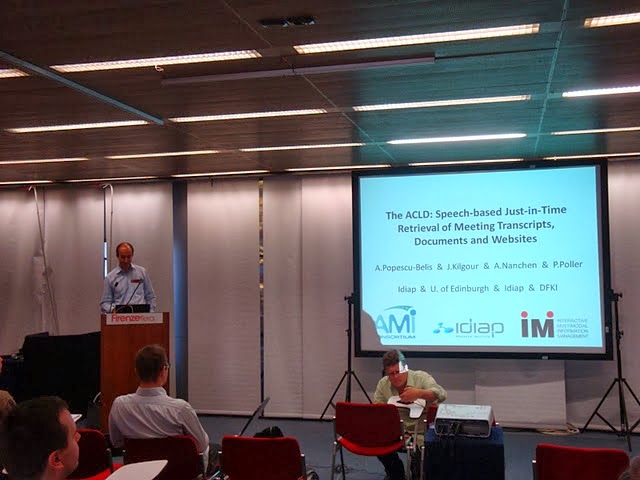
Sometimes it takes writing a blog entry to refocus on the core values of multimedia search. I was going through the pictures from the Searching Spontaneous Conversation Speech workshop in order to find a good one to add to the latest newsletter report, and dang it, if there weren't so many speaker pictures that we ruined because Florian is crouching in the middle in the front, tending to the laptop that we were using to capture the sound.

At Interspeech we discussed the idea of simply recording all the spoken audio at both the MediaEval 2010 workshop and the SSCS 2010 workshop in order to start an audio corpus of workshops to use for research on meeting retrieval. It sounded like a good idea that we would never have the time to pull off, but sure enough, there we were in Italy, and a network of people came together and brought sound equipment from all over and we had ourselves a system for audio capture. I remember the satisfaction in his voice, when Florian announced "We are now recording six channels". Actually, I remember it because I listened to it on the recording afterwards as we started the laborious process of post-processing and I wondered "Gee, what kinds of things were we talking about next to the main presentations."

So here's the refocus. Florian isn't actually ruining the picture. His presence actually underlines what the speaker is talking about -- the slide reads "The ACLD: Speech-based Just-in-Time Retrieval of Meeting Transcripts, Documents and Websites". We have made such a huge step in this direction that in are own lives we can simply decide to capture our spoken content, everyone at the workshop says, "OK, that's cool" and bang we have more data than we know what to do with.

We also did this at SSCS 2008 in Singapore. The videos were online for a while -- we transcribed them using Nuance Audiomining SDK for speech recognition and made them searable with a Lemur-based earch engine. For awhile, we could visit a website and search our own dogfood, as it were. It seems, however, that the multimedia lifecycle got the better of our content: the system was not maintained and now the videos are no longer available online. I don't know if we'll do much better this year, but the point is that we keep on trying. And we have Florian in the middle of the workshop picture reminding us that this attempt may be time consuming, but it is constitutes the core of our research mission.