Wet leaves abound on the ground these days in Europe, and when I walk the streets they lead me to think about the critical role that friction plays in our worlds. I own a special pair of dance shoes that give just the right amount of friction to let me glide across the floor. More would prevent me from dancing. But less, oh, less could be disastrous---movement from one spot to another would be uncontrolled and dancing would be impossible.
If you stop to think about it, it really is a similar phenomenon that makes the stories that we tell interesting. Imagine that there were no friction and that the punchline of a joke would always simply slip out of our mouths with the first line. Its not a nasty as taking a tumble during the tango, but if we collectively lost the ability to tell jokes and stories, it would not be making the world a better place.
For us to entertain each other in this way, some kind of an "information friction" is necessary, i.e., a force that holds back everyone knowing everything all the time.
This observation seems a bit of a trivial, given that concerns about eroding "information friction" are more frequently related to "big issues" involving, e.g., involving safety in society.
For example, people worry about private information being leaked that can do them serious damage. This is a legitimate concern. We are thankful when the dangers of sharing are treated constructively by the news media, e.g., ConsumerWatch: Social Media Users May Be Revealing Too Much About Location « CBS San Francisco
Here, the benefit of information friction is clear. On Twitter information about people's location travels as far and as fast as light. Unlike light, it's not gone once the source stops emitting, but rather hangs around and reveals patterns capable of haunting or even hurting, should they be traced and exploited by people with evil intent. We still want to share with others around us, but this sharing should have some natural limits, just like the physical forces that keep us from flying around without control in the real world.
We share the vision of a world in which governments can exploit patterns in real-time personal data to prevent of mitigate the effects of epidemics and catastrophes: http://www.theguardian.com/media-network/media-network-blog/2013/sep/05/combating-epidemics-big-mobile-data
But another "big issue" is that we don't want to trust every government with all the data in the world. We would appreciate a bit of information friction if it could keep our data a bit closer to home and in hands that we feel we can count on because we know them well.
Here, I would like to explore another, less dramatic aspect to information friction: I would like to highlight the critical role that friction plays in the fun, loveliness and delight of life. In addition to jokes, as I described above, think also about movies. We see online communities carefully creating information friction: adding spoiler alerts so that viewers don't come to know the end of the movie until the time is perfectly right for it.
Browsers offer private browsing, which seems to me the only way that it is possible to buy anyone a gift these days---anyone (family member, roommate, colleague), that might happen to glance at the screen of your computer that is. Currently, my browser is happily showering me with recommendations for flights to the destinations that I have recently investigated using my search engine. Some may see benefit in this added inconvenience for people who are trying to deceive their loved ones. But the romantics among us regret the passing of the days in which we could book a surprise getaway trip for two without having to remember to adjust the browser settings.
We need a certain amount of information friction to make it possible to give gifts to each other. To surprise each other with unexpected kindnesses. To perform magic tricks, pass on secret recipes to the next generation, to have fun with puzzles and riddles and generally create a sense of joy and wonder.
So yes, limits to the flow of information will keep us safer from the dangers of misuse or misinterpretation of private data by evil others. But it will also keep the underlying exchanges that bind us together in relationships, social groups and societies alive and well. We need to be able to tell each other stories and to give each other little presents. For these exchanges to work, information friction must be balanced to admit flow, but also to restrict it in just the right way.
It's not a simple balance to achieve. In the real world, so much is simply handed us by physics. Friction simply exists and doesn't have to be created for a specific purpose. The digital world, on the other hand, provides a serious challenge: we can't count on social gravity giving us a constant acceleration.
I'll end by noting the reason that I think it is so important to relate the need for the right amount of information friction not only to "safer societies" but also to the smaller things like jokes and surprises, what I call "subtle satisfactions" in the title of this post. It is fatiguing to self-control our level of social sharing with alarmist thoughts preventing the revelation of too much information leading to burglary or kidnapping. Rather, our brains prefer focusing on the enjoyable and comforting parts of life. We can exercise a more gentle rein by considering the positive: Contributions to protecting individuals' privacy online also uphold a world where your loved one can give you the most wonderful gift of your life on your birthday without having to execute technical gymnastics.
Rather than only working towards an world in which bad things are impossible, we should realize that we are also working towards a world in which the good things stay possible. Achieving and maintaining information friction balance is a lot of work, so I do not doubt that we can use both motivators.
Showing posts with label social networks. Show all posts
Showing posts with label social networks. Show all posts
Sunday, November 10, 2013
Wednesday, August 8, 2012
Worry-Free Social Sharing for Social Networks
 |
| Flickr: Phil Wiffen |
In contrast to smoking, social sharing done right actually helps rather than hurts. In fact, the rise of online social networking and social multimedia sharing has been downright amazing technological development. Moved by this awe, last year in a project proposal, I effused that social networks are, "...a virtual prosthetic that extends the strong fabric of social connectivity critical to the well-being and growth of human societies into the online realm."
That proposal developed the idea of "worry-free social sharing": a social sharing client that would gently alert us when our sharing actions, in ways we do not intend, threaten to compromise our privacy---and then suggest alternative actions, which allow us to share our personal experiences, but in a wiser way.
Yes, people are responsible for their own actions. But in some cases, we as individual users do not have the understanding of multimedia analysis technology, or of the power of algorithms to combine different sorts of data to reveal facts about us that we thought were hidden. We all would need such understanding in order to allow us to make informed decisions about which types of social sharing is harmless and which types should better be avoided.
Even for the most savvy of us there are always surprises: Did you know that if you upload a video to YouTube and you carefully avoid geo-tagging it, but if you happen to be in a city and capture an ambulance siren in the background, that siren will serve to indicate in which city you are? Check out the work on multimodal location estimation [1]. Maybe you don't care if the world knows where you are, but if you do happen to be worried about having left your house empty during your vacation, it would be good to know that you just about betrayed your location to the world without realizing it. I've written about this before, e.g., in this post that mentions cybercasing.
It is within the reach of technology to build a "worry-free social sharing" client. The problem is getting the research funding to do so. Industry doesn't really have an interest in having users start being concerned about the implications of their sharing behavior. (It's in their interest to just send the message "share more".) Sure, it's unpleasant and possibly off-putting to have to reflect on the fact that someone might break into your house based on information about your location gleaned from videos that you post to YouTube. But is seems to me that "worry-free sharing" is an idea that users could identify with: just like the cereal box in the morning that announces how much fiber and how many vitamins we are consuming promotes consumption rather than driving people away from a product.
Another project proposal won the competition over the "worry-free social sharing" idea. One of the professors involved in the review later informed me that "worry-free social sharing" sounded like something female. I wasn't really sure what to do with that remark beyond thinking that it probably wasn't one of the considerations for the decision and storing it away for future reference.
I hadn't thought about the femaleness of privacy protection until this weekend, during the new Batman Movie. Here, we watched Cat Woman chasing something called "Clean Slate". She knows that what she needs in order to live her life the way she wants it is to make a clean break with the past. But Batman eventually recognizes this too. And I am happy to see other voices online interested in the privacy themes of the Batman movie. So I am not going to assume that there is only one half of the world population that would be interested in "worry free" sharing solutions.
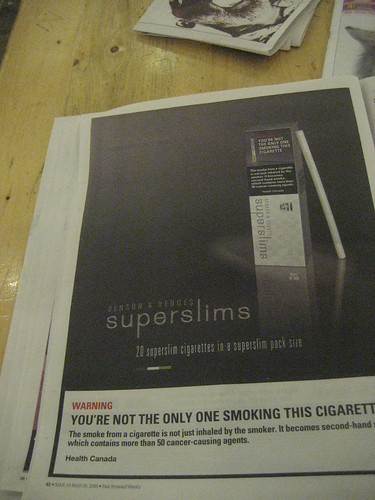
Thinking about Batman also brought me back to the parallel with the cigarette warning label case. The label pictured above warns of the dangers of second hand smoke, "You're not the only one smoking this cigarette." If warning people about the dangers for their near and dear ones motivates people to cut back or stop smoking, maybe the same effect is true of social sharing. The "worry-free social sharing" client can remind us: Hey, you don't mind posting this picture, but maybe it will have unintended consequences for your friend, who is also pictured.
If you don't believe me, believe Batman: "You wear the mask to protect those you love."
Gerald Friedland, Oriol Vinyals, and Trevor Darrell. Multimodal location estimation. In Proceedings of the international conference on Multimedia (MM '10). ACM, New York, NY, USA, 1245-1252.

Subscribe to:
Posts (Atom)