Friday, November 19, 2010

Search your own dogfood

How many hours do I spend writing deliverables and reports? I'd rather not count. Here I am on Friday night with a to do list left over from the week that seems only very vaguely connected to my main mission as a researcher, namely to improve multimedia access systems, especially for spoken audio and video with a speech track.

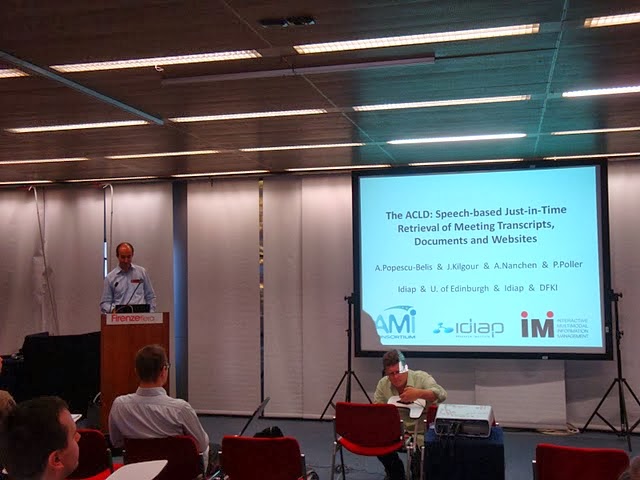
Sometimes it takes writing a blog entry to refocus on the core values of multimedia search. I was going through the pictures from the Searching Spontaneous Conversation Speech workshop in order to find a good one to add to the latest newsletter report, and dang it, if there weren't so many speaker pictures that we ruined because Florian is crouching in the middle in the front, tending to the laptop that we were using to capture the sound.

At Interspeech we discussed the idea of simply recording all the spoken audio at both the MediaEval 2010 workshop and the SSCS 2010 workshop in order to start an audio corpus of workshops to use for research on meeting retrieval. It sounded like a good idea that we would never have the time to pull off, but sure enough, there we were in Italy, and a network of people came together and brought sound equipment from all over and we had ourselves a system for audio capture. I remember the satisfaction in his voice, when Florian announced "We are now recording six channels". Actually, I remember it because I listened to it on the recording afterwards as we started the laborious process of post-processing and I wondered "Gee, what kinds of things were we talking about next to the main presentations."

So here's the refocus. Florian isn't actually ruining the picture. His presence actually underlines what the speaker is talking about -- the slide reads "The ACLD: Speech-based Just-in-Time Retrieval of Meeting Transcripts, Documents and Websites". We have made such a huge step in this direction that in are own lives we can simply decide to capture our spoken content, everyone at the workshop says, "OK, that's cool" and bang we have more data than we know what to do with.

We also did this at SSCS 2008 in Singapore. The videos were online for a while -- we transcribed them using Nuance Audiomining SDK for speech recognition and made them searable with a Lemur-based earch engine. For awhile, we could visit a website and search our own dogfood, as it were. It seems, however, that the multimedia lifecycle got the better of our content: the system was not maintained and now the videos are no longer available online. I don't know if we'll do much better this year, but the point is that we keep on trying. And we have Florian in the middle of the workshop picture reminding us that this attempt may be time consuming, but it is constitutes the core of our research mission.

Friday, October 29, 2010

ACM Multimedia SSCS 2010 Workshop on Searching Spontaneous Conversational Speech

The Fourth Workshop on Searching Spontaneous Conversational Speech took place on 29 October 2010 at ACM Multimedia. Papers were presented about techniques for speech retrieval, speaker role recognition, spoken term detection and concept detection. Invited speakers addressed challenges for the future of spoken content retrieval, including interview data, multimedia archives and the Spoken Web. The demonstrations were a highlight of the workshop. These were first introduced in a boaster session and then presented to workshop participants in an interactive session. Here's the Wordle Word cloud made from the title and the abstracts of all the papers presented!

Currently, we are getting ready for an upcoming special issue on searching speech in ACM Transactions on Information Systems.

Sunday, October 24, 2010

MediaEval 2010 Workshop Report

We were delighted that Bill Bowles attended the MediaEval 2010 workshop and that he made us our own MediaEval video trailer, in which he tells the story of MediaEval from his own point of view. The MediaEval 2010 Affect Task was devoted to analyzing Bill's travelogue video from his Travel Project and ranking it by how boring viewers reported it to be. As a filmmaker, another rational reaction would be "Who are these people, what did they do to my video? I don't want to get anywhere near them!" But instead, he came, participated and told us about ourselves using the very same medium we devote so much effort to studying.


I was amazed at how quickly this video accumulated views, it quickly outstripped any video I've ever posted to the Internet. However, if video is not your thing and you want the text version of what happend here is the text of a workshop report written for a project newsletter.

MediaEval 2010 Workshop Report

The MediaEval 2010 workshop was held on Sunday, October 24, 2010 in Pisa, Italy at Santa Croce in Fossabanda. MediaEval is a benchmarking initiative for multimedia retrieval, focusing on speech, language and contextual aspects of multimedia (geographical and social context) and their combination with visual features. Its central sponsor is the PetaMedia Network of Excellence. In total, four tasks were run during MediaEval 2010. To approach the tasks, participants could make use of spoken, visual, and audio content as well as accompanying metadata. Two “Tagging Tasks’ (a version for professional content and one for Internet video) required participants to automatically predict the tags that humans assign to video content. An ‘Affect Task’ involved automatic prediction of viewer-reported boredom for Travelogue video. Finally, a ‘Placing Task’ required participants to automatically predict the geo-coordinates of Flickr video. The Placing Task was co-organized by PetaMedia and Glocal. It was also given special mention in the talk of Gerald Friedland entitled “Multimodal Location Estimation” in the “Brave New Ideas” session at ACM Multimedia 2010.

During the MediaEval 2010 workshop, researchers presented and discussed the algorithms developed and the results achieved on the MediaEval 2010 tasks. The workshop drew 29 participants from 3 continents. More information about the 2010 results including participants’ short working notes papers, are available at: http://www.multimediaeval.org/mediaeval2010
Currently, MediaEval 2010 participants are working towards a special session at the 2010 ACM International Conference on Multimedia Retrieval (ICMR 2010), which will be dedicated to presenting extended results on MediaEval 2010 tasks.

Mediaeval 2011 will be organized again with sponsorship from PetaMedia and in collaboration with other projects from the Media Search Cluster. The task offering in 2011 will be decided on the basis of participants' interest, assessed, as last year, via a survey. At this time, we anticipate that we will run a Tagging Task and a Placing Task as well as a couple innovative other, new tasks as dictated by popularity. If you are interested in participating in MediaEval 2011 or if your project would like to organize a task, please contact Martha Larson m.a.larson@tudelft.nl Additional information on MediaEval 2011 is available on the website: http://www.multimediaeval.org

Saturday, October 9, 2010

Drink recommendation

Within the last ten days I've been in Asia, Europe and North America. I've taken jetlag to a new level. Usually there is a reference point, you can say, "It's past midnight in the Netherlands at the moment, my internal clock thinks it's past my bedtime and that's why I am so tired." Now I have no clue why time my internal clock reads.

At the grocery store, I just picked out a four pack of energy drink in order to try to jump start myself and get re-aligned with the cycle of the sun at my current location. I stood for ten minutes in front of the selections, looking at the cans and then reading the labels. I wanted something not too expensive, sugar free and also with guarana. A Brazilian colleague had recommended guarana as one of the best "pick up" ingredients you can get in an energy drink.

What I could use is a good drink recommendation system. The Asian part of this odyssey took place in Tokyo, and the following video was what YouTube there listed as a popular video. It had received 44466 views in the one day since it had been uploaded.

1 dag geleden 44466 keer bekeken


It is a news report on a drink vending machine (a Tokyo fixture) that recommends drinks by taking your picture and doing a little bit of multimedia content analysis that gives it clues as to your age and gender.

In my current situation, age and gender wouldn't have been enough. Rather the system would need information about my internal state -- the camera would have to have noticed the unfocused glaze of my tired eyes. In this situation, internal-state information could be inferred if the system had access to information about my geo-coordinates within the last ten days. Access to a recent history of my sleeping-waking pattern would provide an even better source of evidence.

However, another key bit of information, that would be critical to get to the correct drink would be that at the moment I do not want to be tired. I can't be tired. I don't want something that will relax me -- no chamomile, not yet. I need to work.

The bottom line is clear: barring a system that has access to all that information and the ability to use it in the right way, the Brazilian colleague remains the best source of drink recommendations.

And it looks like the drink is working already, since I have already reached a level of alertness to attempt a blog post.

Tuesday, September 28, 2010

Where's Wikipedia?

The ACM Multimedia Grand Challenge is a high-adrenaline event where researchers from the Multimedia community compete against each other to develop the best solutions to problems posed by industry. For example, Google formulated two challenges, Video Genre Classification and Personal Diaries, in this year's competition.

Today in Tokyo at Interspeech 2010, I stopped to chat with last year's Grand Challenge winner, who is competing once again this year. I was struck anew by the realization that in the pressure-cooker of the Grand Challenge, creativity, raw intelligence, technical competence, competitive drive and off-beat thinking gives rise to lines of attack that might never have emerged in a traditional R&D setting. Such solutions stand to benefit us all.

But is it really only industry who should be formulating the challenges for such competitions? Where, for example, is Wikipedia? If there is any major player in the Internet information arena that deserves a crowd-sourced solution from the research community, it is Wikipedia, the knowledge resource homegrown by collaborative effort.

Wikipedia does truly inspire the research community. Very recently I've witnessed up close how fired up scientists get about Wikipedia. The Tribler team, who sit on the ninth floor of our building, have been sinking unbelievable time and effort into the development of the Swarmplayer V2.0. Their dedication is inspiring and their incredible belief in the power of a distributed solution for videos on Wikipedia is infective.

Datasets from Wikipedia have been used by multiple benchmarking initiatives such ImageCLEF and INEX as well as in MediaEval, the benchmark I co-ordinate. We certainly enjoyed coming up withour own Wikipedia-related task. However, it would be great to hear directly from the Wikimedia Foundation, in the form of a Grand Challenge, what problems they see on the horizon in the next 2-5 years for which the research community could be helpful in generating solutions. The Challenge takes the form of a simple textual description of the problem and researchers do the rest, presenting the solution in form of a system or system demo and a paper describing it.

There's a lot out there of course that I don't know about. For example, just read this post on the ECML PKDD 2010 Data Challenge: Measuring Web Data Quality. But I've never seen a clear Challenge originating from the Wikipedia community and published for the research community.

One aspect that researchers need to think seriously about, however, is the form in which solutions for Wikipedia or developed using Wikipedia data are published. ACM Multimedia Proceedings are not an open access publication. It's a contradiction to carry out research on a free knowledge resource and publish results under conventional copyright. Peer-reviewed open access journals such as the Journal of Digital Information should be preferred when publishing results obtained using Creative Commons licensed data.

Maybe that's actually one Challenge that the Wikimedia Foundation actually has to offer the research community: challenging us to breaking the habit of creating solutions in a rush of creative joy and technical muscle, and then publishing them where they cannot be accessed by everyone.

Saturday, September 18, 2010

MediaEval Tagging Task Professional

DIXIT, a Dutch-language journal for speech and language technology, invited me to do a piece on the "Tagging Task Professional", one of the four multimedia indexing and retrieval tasks that the MediaEval benchmarking initiative ran in 2010. I am posting an English version of the text here on my blog. The piece will appear in December, after the MediaEval 2010 workshop in October (I note that in order to explain the past tense used to describe an event that has not happend yet).

The workshop will be held in a medieval convent called Santa Croce de Fossabanda, located in Pisa, Italy. The photo here is from Flickr user Marius B, licensed under Creative Commons License by-nc-sa. I notice that I do well with attribution if I am going to print material (brochures etc.), but I get sloppy with Power Point. If I know this photo is on my blog, I will be able to mind myself it comes from Marius B quickly in case I want it in future presentations.

Many Minds Make Light Work: Bringing Researchers Together to Work towards Automatic Indexing for Cultural Heritage Multimedia Collections

"Medieval", "mediaeval" and "MediaEval" are all pronounced the same. While "medieval" and "mediaeval" are alternate spellings for a adjective describing something that occurred in the Middle Ages, "MediaEval" is a benchmark initiative that brings researchers together to tackle challenging tasks in the area of multimedia indexing and retrieval. In 2010, a group of researchers worked individually and then met at a medieval convent "Santa Croce in Fossabanda" in Italy. Can a group of MediaEval scientists solve today's challenges of automatic generation of metadata for cultural heritage multimedia content?

Cultural heritage content often takes the form of multimedia and in particular of audio and video recordings. Cultural heritage collections are often staggering in size. The archive of the Netherlands Institute for Sound and Vision houses a breathtaking 250,000 hours of video content and receives and additional 8,000 hours of content broadcast by national broadcasting companies each year. Material that is stored in such a huge collection, but is not adequately annotated, is useless since it can no longer be found by people who wish to view, reuse or otherwise study it. Professional archivists have developed a set of techniques for annotating material with metadata for storage in the archive that will ensure that it can later be found. These techniques have stood the test of time and will continue to be critical for finding multimedia content in large archives in the future. The ability to generate high quality metadata, however, is not enough. Rather, metadata production must be scaled so that incoming material can be appropriately annotated at the rate at which it arrives.

Techniques from the area of Speech and Language Technology hold promise to support archivists in the generation of archival metadata. Here, we specifically look at the problem of generating subject labels (or "keywords") for television broadcasts. Subject labels are terms drawn from the archive thesaurus. Examples of keywords are, Archeology (archeologie), Architecture (architectuur), Chemistry (chemie), Dance (dansen), Film (film), History (geschiedenis), Music (muziek), Paintings (schilderijen), Scientific research (wetenschappelijk onderzoek) and Visual arts (beeldende kunst). Automatic generation of subject labels can help archivists in one of two ways: by providing a list of suggested subject labels for a video, thus narrowing their field or choice, or, by automatically generating a best guess in order to label material which would otherwise go un-annotated due to huge volume of incoming video material and the time constraints of the archive staff.

Automatic generation of subject labels is accomplished by algorithms that make use of several data sources: production metadata for broadcasts, transcripts of the spoken content of broadcasts produced by automatic speech recognition technologies and analysis of the visual content of the broadcast recording. The algorithms apply statistical techniques including word-counts and co-occurrences and also machine learning methods. Current algorithms are, however, far from perfect and their further improvement requires sustained and concerted effort on the part of research scientists.

Many researchers are interested in working on the problem of automatically generating subject labels for cultural heritage material. However, in order for a researcher to begin working in this area, a number of problems must be faced.
  1. It is necessary to have an understanding of the problem -- requires a general knowledge of how subject labels are produced in the archive and what they are used for
  2. It is necessary to have access to a large amount of example data in order to develop and train algorithms
  3. It is necessary to have access to data sources such a speech recognition transcripts or visual features. In general, it is not possible to generate these resources in a lab that is not already specialized in these areas
  4. It is necessary to understand the work that has previously been carried out in the area in order not to duplicate techniques that have already been tried by other researchers
  5. It is necessary to know how well one's own algorithms compare to the current state of the art.
The purpose of a benchmarking initiative is to address these problems and let researchers concentrate their energy on the hard work and creative thinking that it takes to develop new algorithms for important tasks. MediaEval is one of several benchmarking initiatives that pursue this paradigm. The special topic area addressed by MediaEval is multimedia, with a focus on on speech, language and social features and how they can be combined with visual features.

MediaEval promotes research progress in the area of automatically generating subject labels for cultural heritage material by running a "Task" devoted to subject labeling for professional archives. A Task is comprised of three parts: a description of the problem, a data set and a set of resources that can be used to solve the problem. Having the problem packaged as a task gives researchers easy entry to understanding the issue from the perspective of the archives and allows licensing of the data from the archive to occur in a streamlined manner. The University of Twente supplies speech recognition transcripts makes it possible for research groups without competence in Dutch-language speech recognition to contribute to developing improved approach to the task. Information about the other tasks offered can be found on the MediaEval website: http://www.multimediaeval.org/

Researchers approach the tasks by first working to solve them individually. They submit their solutions, which are evaluated by the MediaEval organizing committee. Because all researchers working on the same task have used the same data set, the solutions are directly comparable with each other and it is possible to see which approaches provide the best performance for the automatic generation of subject labels. Researchers then gather at a workshop in order to discuss the results, build collaborations and plan approaches for next year. The workshop fosters friendly competition between sites necessary for progress on the issues, but also builds collaboration encouraging sites to bundle their efforts and to avoid duplicating investigation on approaches that have already been shown to be less fruitful.

The MediaEval 2010 workshop was held in Pisa, Italy in October 2010 directly before ACM Multimedia, a large multimedia conference. It was held in a medieval convent "Santa Croce in Fossabanda" that had been converted into a hotel with seminar facilities. A site so evocative of the beauty and the value cultural heritage was particular suited to host researchers focused on the issues that will help improve automatic indexing of tomorrow's cultural heritage content.
Tuesday, September 14, 2010

Affordance

"People," continued the taxi driver driving me to the airport in Dublin, "do the strangest things with chocolate." He paused, reflectively, before adding, "I mean in private."

When I didn't immediately respond, he hurried to explain himself. "You know, a Bounty bar?" I did. "I pick the chocolate off of the outside and then eat the inside separately. Do you do that?" As politely as I could I explained that I didn't like Bounty bars. "What do you do then?" he asked. The best thing that I could come up with was Oreo cookies, that I twist them open and eat out the middle, "A lot of people do that," I added. This puzzled him, until he brightened, "Oh, I heard about this biscuit in Australia and you bite off two of the corners and you drink your tea right through the biscuit. It has some sort of a cream filling that just melts as you drink. It's supposed to be just lovely." He thought for a moment. "It's Tam Tam or Yam Yam or something like that it's called."

I tried to imagine the Tam Tam or the Yam Yam and what it might look like. I was in Perth for about four days after SIGIR 2008, but didn't remember any cookies like that. "Do you suppose," I asked him, "that people just take the biscuit out of the package and look at it and think, 'oh, I should break off two of the corners and drink my tea through it' or was there one person who invented it and then it quickly spread as an idea throughout Australia?"

His response surprised me: he laughed! Then, "It's like the comedian," he pronounced. And then he filled me in: there is a comedian one-liner about watching a chicken lay an egg. "Hey, I think I could eat that!" was the punch line.

And so, I end up discussing with a Dublin taxi driver, the principle of affordance, the ability of an object to be acted on in its environment, and, in a larger definition, communicate its use via its appearance.

In multimedia information retrieval, I am obsessed with affordance in this latter sense. At the first glance or very quickly during interaction, the system should implicitly communicate to the user what it does, what the user can do with what it does and the extent to which it can be trusted to reliably do what it does in all cases.

A few years ago, I believed that a speech retrieval system should not show transcripts to users because users are disturbed by errors. Now we are all a lot further. People are used to reading relatively unedited or unconventional text in text messages, blogs (!) and comments. Now, the level of error can signal to the user that the text has been created by a speech recognizer and how well that speech recognizer can be trusted to capture the spoken content of the audio signal.

But his is negative affordance, the message what can't this system do. It is quite possible that negative affordance is much more challenging to communicate to the user since the space of possible non-uses is not intuitively constrained.

And with biscuits, of course, comes the problem of distributed affordance. What works well once does not continue working well with repeated applications. The package of biscuits should tell you, individually, we are delicious, but if you eat the whole package you won't feel nice and full, but instead you will have an unhappy stomach. Even it was written explicitly on the package, I imagine I would mostly ignore that message.

This is Part III (final part!) of the "Irish Chocolate Discussion", reflections on the conversation I had with a Dublin taxi driver and how that relates to finding things and search systems in general.